

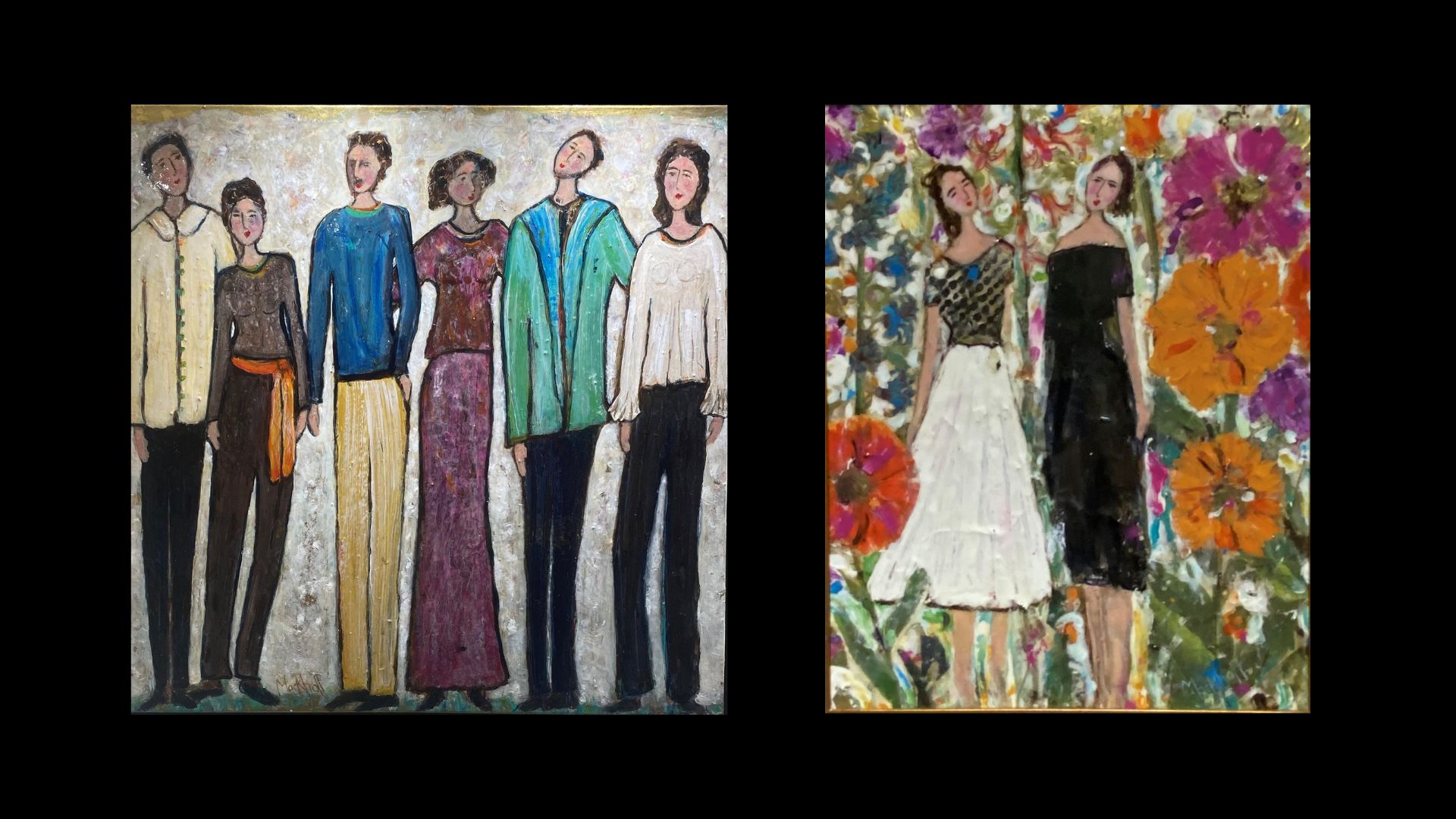
Psalm and Celebration
by Holly Markhoff
In the Bodzin Art Gallery until June 26, 2026
Holly Berger Markhoff is a contemporary mixed media artist known for her figurative and expressive paintings. Her work incorporates sculptural elements as she builds up paint between layers of glaze, creating a glass-like translucence. Holly lives in Richmond, Virginia, and her work can be found in galleries; private, nonprofit, corporate, and museum collections; and staged in the 2021 Hulu mini-series, Dopesick.
For several years, Holly was my counterpart at the Sara D. November Gallery at the Weinstein JCC in Richmond. Curator to curator, we would share ideas and introduce each other to artists. On a visit to NYC last spring, I happened upon the Heller Museum at Hebrew Union College-Jewish Institute of Religion in Greenwich Village and saw Holly’s name included in a group exhibition called Seeking Joy. I hadn’t known she was an artist, and this show emerged from that auspicious gallery visit.
Psalm and Celebration is a commentary about the gift of resilience and responsibility to move forward during or following times of loss and challenge. It was inspired by her personal reaction to the COVID-19 pandemic and international tensions and tragedies, including those in Israel beginning on October 7, 2023.
I’m delighted to share my conversation with Holly, curator to artist, about her show.
You describe this body of work as holding both grief and celebration. How do you visually balance those emotional opposites within a single piece?
I visually balance grief and celebration by allowing both emotions to exist subtly within the same scene. Much of my work has always centered on uplifting moments, hopefulness, and the sacred beauty found in everyday life. The prolonged experience of the COVID-19 pandemic, along with the devastating loss and conflict in Israel on and after October 7th, challenged me to explore how joy can still exist alongside profound sorrow.
That tension became an important question in my work: how can my art honor pain and loss while still offering optimism, continuity, and hope? In response, I began curating a collection of pieces that hold these emotional opposites together rather than separating them.
Silent Celebration, created in 2022, was the first work in which I consciously explored this balance. The women in the painting wear festive clothing and party hats, symbols of joy and celebration, yet their expressions are quieter and more restrained. Visually, the piece carries both warmth and emotional weight, reflecting the reality that even in moments of celebration, someone nearby may be carrying deep sadness.
That painting became the foundation for the larger body of work, Psalm and Celebration. Centered on the idea that joy can coexist with grief, and that celebration expressed with humility and sensitivity can itself become a form of resilience and hope, the collection is deeply rooted in Jewish tradition. Beneath the joy of the wedding chuppah, a glass is broken, suggesting that it is a sacred responsibility to remain sensitive to brokenness while also celebrating life and engaging in repair.
Shabbat and Simchat Torah appear in your art, among other Jewish imagery. When did Judaism start to inspire the content of your art?
It is through my art that I began to recognize how deeply I see and express the world through Jewish eyes. I did not begin by consciously setting out to create “Jewish art.” Rather, over time, I began to notice that many of the artists and works I was most drawn to were created by Jewish artists. That realization helped me understand that my own work also carries a distinctly Jewish voice, even in pieces that are not overtly Judaic in subject matter.
During my time as curator of the Sara D. November Gallery at the Weinstein JCC in Richmond, Virginia, I had the privilege of looking closely at the work of other artists. I absolutely loved that process, and I grew as an artist by being exposed to so much beautiful artwork. I discovered a number of qualities I value and would like to continue or develop in my own work. I still spend many hours learning from the works of other artists through museum and gallery visits, websites, and social media.
I think that my specifically Judaic work has been shaped by a lifelong involvement in Jewish learning and education. I have taught Hebrew language and Judaic studies for more than 25 years, and I have also continued with ongoing Judaic education through courses, workshops, and educational opportunities. Judaism offers me a deep sense of beauty and a meaningful view of the world. I think the optimism that runs through much of my work is inspired by Jewish concepts such as the belief in sacredness, resilience, responsibility, and hope.
Your art has been inspired by Amadeo Modigliani (1884–1920, Italy – and Jewish!) and Gustav Klimt (1862 – 1918, Austria). Can you share more about these inspirations in your artistic process for this body of work?
Both Amedeo Modigliani and Gustav Klimt have had a large influence on my artwork, though in different ways. I am especially drawn to the gold highlights in Klimt’s paintings, which inspire my use of materials and detail work, such as the metallic gold throughout much of my own work. When many of my pieces are viewed under proper lighting, the golden accents become more pronounced and bring an added dimension and luminosity to the paintings. I am also inspired by Klimt’s intricate patterning, rich textures, and his expressive portrayals of women.
I also love the work of Modigliani, and his influence can be seen more in the composition, movement and emotion of my figurative pieces. I am inspired by the body language in his work and the way his figures communicate feeling through their posture, gesture, and elongated form.
What advice do you have for aspiring artists?
Create a space where your artwork can remain set up, and dedicate consistent time to practicing. I believe making art is about much more than waiting for creativity or inspiration to happen. Some of my most creative pieces have emerged after spending time on the more tedious details of other works, or even simply organizing my studio. If you give yourself the consistent time and space, the rest will follow!
Take photos of your work, both completed and in stages of progress. Keeping a visual record allows you to track your growth, revisit ideas, create reproductions, and better understand how an idea has developed.
Keep in mind that the way you frame or present your work communicates its value. Think about how meaningful a gift feels when it is beautifully wrapped and thoughtfully presented. Presentation shapes the initial perception people have of your art before they even begin to engage with the work itself. If self-hanging work, don’t clutter. Less is more! When framing, no frame is better than a noticeably damaged frame or one that doesn’t present the work well.
The power of a cohesive body of work will open doors. One exceptional piece can spark recognition and boost confidence, but a thoughtfully connected collection of work makes a powerful statement when presenting yourself for potential opportunities or to galleries.
Find a good mentor, someone you feel comfortable with, and who is willing to share their journey and guidance. Learning from someone else’s experience is very valuable.
Dream BIG, while also setting small, manageable goals that will help build confidence and develop a following of people who recognize your work. Powerful pieces will always be noticed, but building a career as an artist is a step-by-step process. One of the most important parts of that journey is developing a style or voice that people recognize as uniquely yours.