Join the J in June to receive $109 off enrollment fee! Learn More.

From Sports to Service: How Tamir Linhart and Golden Boot Soccer Create Community at the J

Thirty years ago, Tamir Linhart never imagined that the game of soccer would define his life’s work—or that the Pozez JCC would become a second home. Today, as the founder of Golden Boot Soccer, Tamir isn’t just coaching athletes; he is weaving together the Northern Virginia community through a shared love of the game and a deep-rooted spirit of service.

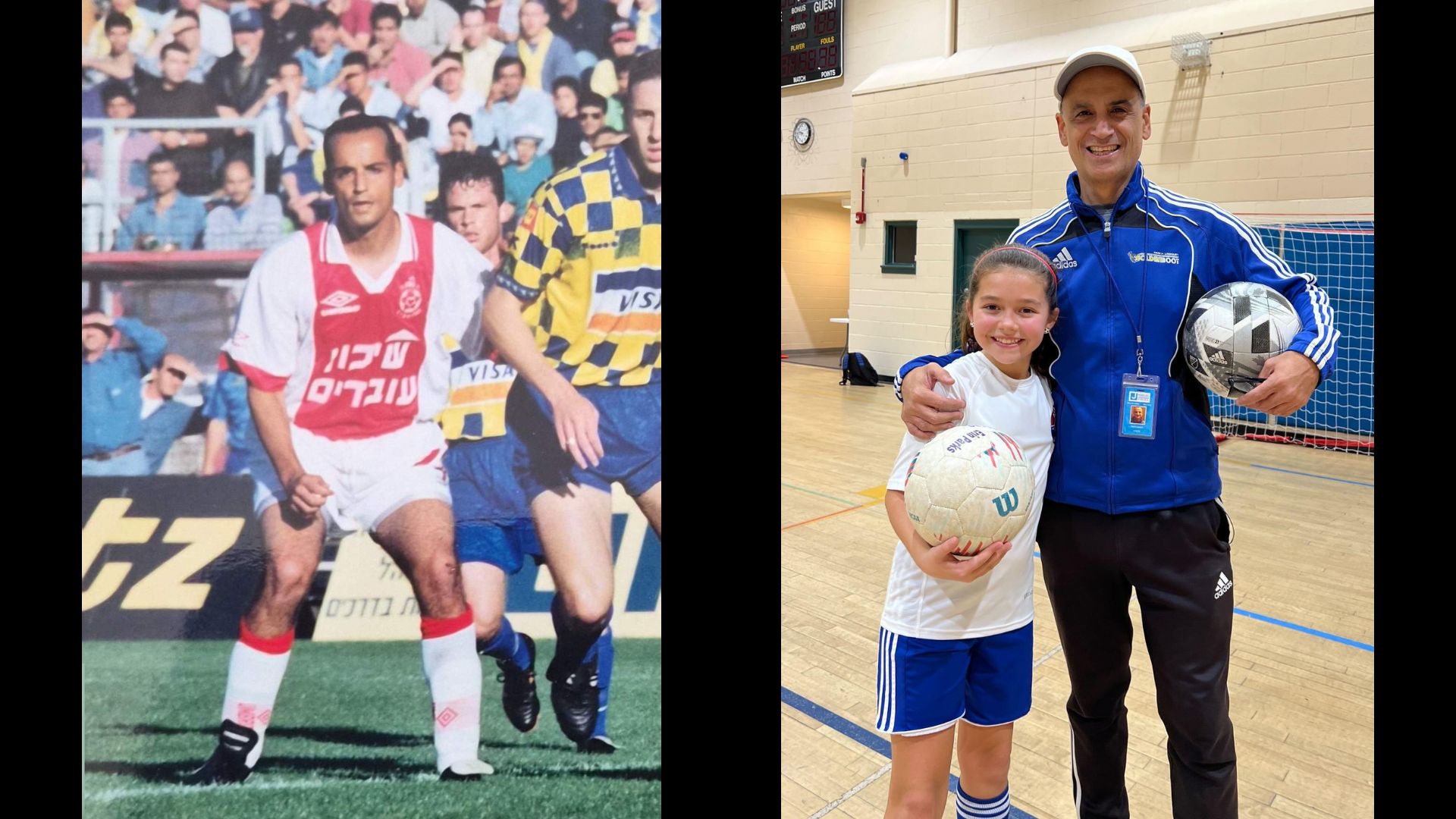
Tamir, an Israeli, played soccer professionally for Hapoel Tel Aviv, a top Israeli club and was a standout member of his college team at George Mason University. He then scored a position on the Washington Warthogs, a professional indoor soccer team owned by the Washington Wizards and Capitals. As his playing days began to wind down, a simple request to coach a young player sparked a new passion.

That coaching gig led to another, and then another. As winter approached, Tamir faced a hurdle… what would happen to his coaching opportunities if he didn’t find an indoor space to practice? He had an idea.

“I just walked into the JCC and said, ‘Hey, I have tons of kids. I have nowhere to play. Is there any way I can use the gym?” The J opened its doors, and Tamir brought his world with him. Leveraging his own players and leaning on his connections within the Washington professional sports community to market his winter soccer program, 200 kids showed up that first winter! That’s when he realized this was no longer a hobby – it was his future.

Thirty years later, the impact is generational. Golden Boot Soccer has served thousands of kids across Northern Virginia. In a full circle moment, Tamir finds himself coaching children of some of his first players and has hired former participants as coaches.

“The J is very special to me because they are the ones who gave me the opportunity,” Tamir says, his gratitude clear. “I don’t think I’d be where I am today without the J. And that’s one of the main reasons I’m still involved. You want to give back.”

At first, Tamir gave back in small ways, donating occasionally or attending events. But when he was given the opportunity to join the board of the JCC, he didn’t hesitate. “I love the people at the J, so I obviously said yes.”

But just being on the board wasn’t enough, he wanted to find a project that touched the heart. When the J partnered with Sunrise Association to create Sunrise Day Camp – Greater Washington, a fee-free camp for kids with cancer and their siblings, he knew how he could make a difference. Now Tamir is an active member on the boards of both the J and its Sunrise Day Camp, pouring his energy into ensuring these families find the same sense of belonging and joy that the J once gave him.

To Tamir, the JCC is the heartbeat of the community—a place where seniors find connection, Israelis find a slice of home, and young people discover their heritage. Through soccer, he subtly weaves Jewish values like Shmirat HaGuf (taking care of the body) and discipline into every drill.

As an Israeli, Tamir wants to engage the Hebrew-speaking community to be more involved. In his mind, the JCC should be a place where all the small communities within Jewish Northern Virginia come together to be one big community.

Golden Boot soccer programs at the J, it turns out, organically achieve some of these goals.

Playing sports, including soccer, teaches Jewish values to kids in unexpected ways. “Physical health is a big factor in Jewish values,” Tamir says. “Discipline, dedication, believing in a goal — those are all very strong Jewish values.” He also serves as a role model for Jewish kids who may harbor the misperception that Jews aren’t typically good at sports and can’t be professional athletes.

Soccer programs at the J also create a bridge between Jews and non-Jews, and Tamir is happy to educate them all about Jewish tradition and culture and the value of a J membership. “They come up to me and ask me questions about what is this and what is that and why do you do this?” Some families start with soccer, but go on to become members, attending other programs and working out in the J-Fit Health Club.

Reflecting on thirty years of growth, Tamir acknowledges that the work of building a community is never truly finished. “There’s a lot of work to do, but the people are wonderful. I’m just really happy to be part of it.”
A Jewish Lens on Conflict Transformation

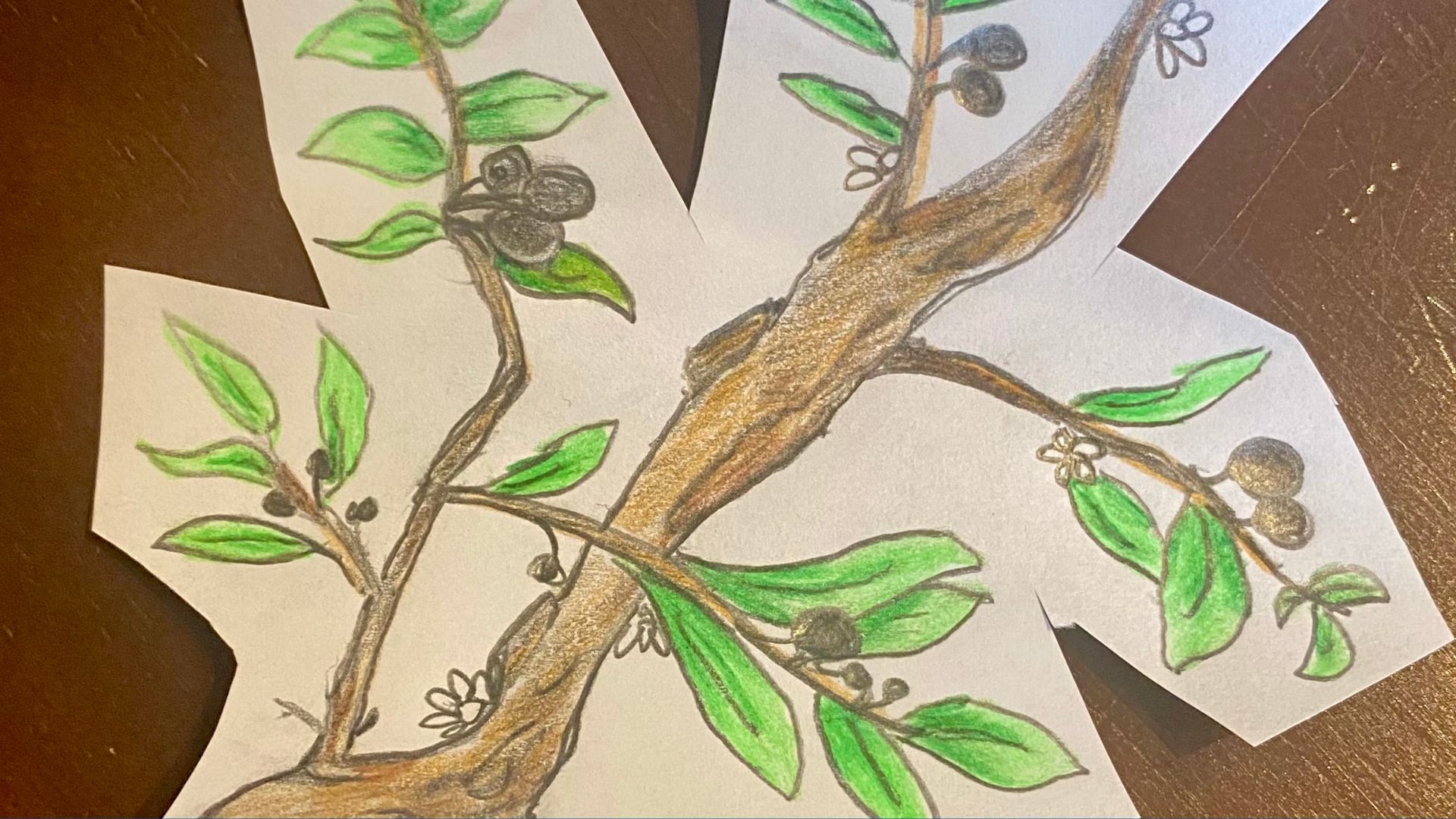
This Passover I added an olive branch to my seder plate.  After doing a bit of research on how to acknowledge the conflicts around the world, I landed on the olive branch as a sign of peace.  In doing so, I realized I might also create a space for dialogue at the Seder table where not every family member agrees on how to achieve peace.  My father encouraged me, reminding me, reminding me to allow everyone to be heard, to build community by acknowledging that differing opinions are both expected and honored. 

This notion was echoed in the Pardes Institute’s Mahloket Matters Fellowship I participated in this fall. A mahloket is a disagreement. The fellowship posited that Jewish teachings promote constructive disagreement, creating space for deeper meaning, relationship building, and better solutions — essentially transforming conflict into a method to build bridges and community. 

What’s Jewish about constructive disagreement?  You may have your own answers for this drawing from your recent Passover Seder or family squabble! Diving into rabbinical texts in the fellowship, we explored the notion that not even Moses was blessed with knowing everything. This humbles each of us to accept that truth for ourselves as well.  We also learned that the Sanhedrin (Jewish supreme religious court) encouraged disagreement (not uniformity) to find better solutions. 

According to Pardes’ Mahloket Matters Fellowship, the four pillars of a constructive disagreement are: 

  1. Debate the issues without attacking people and harming relationships. 
  1. Check your motivation.  Are you trying to win or to understand and solve problems? 
  1. Listen to the other side and be open to admitting that you might be wrong. 
  1. Consider that you might both be right despite holding opposite positions. 

In the spirit of constructive disagreement, I used the olive branch on my seder plate to open a conversation where the diverse perspectives at my table could be respected.   

This spirit is what led me to the Pozez JCC, where we build community every day by listening to everyone and making space for disagreement.  The six J-Family Ambassadors I support are opening conversations with young Jewish families looking to connect and build community throughout Northern Virginia.  They are creating events based on their community’s expressed desires and meeting people where they are to support growing families and their Jewish identity. 

The Pozez JCC has supported the J-Family Ambassador Program from its inception here in Northern Virginia and promotes an environment of learning and dialogue. Pozez leadership also encouraged my participation in Mahloket Matters, recently hosted a workshop from For the Sake of Argument (a program that also builds skills for constructive disagreement), and continues to support diverse and thoughtful programming with a welcoming communal atmosphere.  We always welcome suggestions, so if you have a program you want to see, please let us know! 

You can join us in the spirit of building a rich, diverse community in any of the following ways: 

  • Come to the Pozez JCC and see what the buzz is about!  You’ll always find a friendly face and an engaging activity, ranging from special events to fitness to Mah Jongg in the lobby.  

The Yoms: An American and Israeli Perspective


We, as a Jewish community, are readying ourselves for holidays that call on us to hold joy and sadness at the same time. They are The Yoms: Yom HaShoah, Yom HaZikaron, and Yom HaAtzmaut.

At sundown tomorrow begins Yom HaShoah, or Holocaust Remembrance Day, which commemorates the millions of Jewish lives stolen by Nazi terror and lifts up stories of Jewish resistance. A week later is Yom HaZikaron, Memorial Day for fallen soldiers and victims of terror in Israel. And then, just 24 hours later, comes Yom HaAtzmaut, Israel Independence Day — linking the very existence of the State of Israel to those who risked everything for it.

Here at the J, we create space with intention, encouraging our community to sit in our pain, learn with and from one another, and engage with remembrance to process our emotions and power our resilience.

The coming days will be meaningful and challenging for our community. To give perspective, Chen Sara Mordechai-Kedar, our shlicha (Israeli emissary), and David Selden, a philanthropist and lay leader with a long-standing commitment to Jewish life, share their experiences on The Yoms and reflect on personal moments of commemoration and celebration.


From Stories to Memory

Our shlicha Chen Sara Mordechai-Kedar is a self-described “Tel Avivian girl” who grew up in Rishon LeZion, a city on the shore of the Mediterranean Sea.

Every year — on the same day, at the same time — she heard the tzfirot, the sirens marking Yom HaZikaron. The first one sounded at sundown, lasting for one minute. The second one blared the next morning for two minutes.

During those moments, all of Israel stopped. Traffic came to a halt. No one moved or talked. Everyone stood in stillness and silence.

“As a kid, you try to be very serious and do this, but sometimes you end up laughing because you’re embarrassed. You’re only starting to understand the rules and experiences of your country,” Chen said. “But when you grow up, and especially after army service, this day completely changes for you.”

As Chen, now 32, grew older, she felt the weight of loss. Yom HaZikaron was no longer a secondhand experience, lived through stories told by a parent or a sibling. She had served as a commander in the Israeli army. She had stories of her own and people she held in her heart on Yom HaZikaron.

“This wasn’t my family’s sadness anymore; it was mine,” Chen said. “I could stand and think about people I knew who died. Suddenly this tzfira, this alarm, was very, very meaningful for me. And I couldn’t imagine hearing a kid laugh during it.”

And now, especially after October 7, transitioning from Yom HaZikaron to Yom HaAtzmaut is a greater challenge.

“Even when everybody is celebrating in the streets,” she said, “I always remember that it’s not so easy anymore.”

For Chen, this year will mark her first time teaching on The Yoms. She is helping to organize a series of programs, including a Taste of Israel, a celebration of Israeli culture and community, and Pass the Trauma, Please, an author talk with second-generation Holocaust survivor Todd Diamond about the effects of generational trauma, loss, and legacy.

Chen plans to draw on her own experiences to help our community learn and tap into the hope of the Jewish people.

“If you have a place like the J that can accept everyone, where everybody’s welcome to come and tell other people in the community what they feel, then that is a very meaningful place,” Chen said. “Here, people can show up and say what is on their hearts.”

Holding Grief, Holding Hope

David Selden, a lifelong philanthropist and poet, was raised in a Zionist home. He was surrounded by stories. Many he wrote himself. Others were passed down, like the story of his grandfather, who escaped persecution in Poland and found refuge in what is now Israel.

“Foundational experiences don’t leave you,” he said. “They persist and they grow and they reform.”

He had many of his own foundational experiences in Israel, beginning in 1973.

David, now 71, was a long-haired college kid in Massachusetts on October 6, 1973 — the beginning of the Yom Kippur War in Israel. He wanted to help, and after speaking with his parents, he went to Israel to volunteer.

His new home was Kibbutz Manara, perched on the northern border of Lebanon. He tended chickens and dodged rockets. He refused to speak English because he was determined to learn Hebrew. Using his arm as a sort of dry erase board, David wrote down Hebrew words so he would not forget them.

“Kibbutz Manara. I live there in my memories,” David said. “It bound me to the people. To history. To my place in that history.”

He stayed long after the war and was there for The Yoms, in a small apartment with his host family and a visitor. On Yom HaZikaron, the visitor wailed louder than the siren, David remembered. He had lost his only son in the Yom Kippur War.

“I can hear him now,” he said. 

Remembrance is personal in Israel, as everyone knows someone who has been killed in uniform or in a terrorist attack. Across a small country where nearly every citizen has to serve to mitigate security threats, loss and sacrifice are a part of daily life.

“From the sirens to the community to the very feelings of those who have suffered the greatest loss of all,” David said, “there’s a lot to be learned by how Israelis mourn together in ways that you can only learn by doing.”

He remembered another moment in Israel: visiting Yad Vashem, the Holocaust museum. David stood before a memorial honoring children who were slaughtered, and then, he stepped outside.

“I saw the hills. I saw life,” David said. “I could express gratitude and look at a future that’s still there and evolving.” 

Then and now, David navigates the tension of The Yoms as he does every day: with poetry. Some of his recent poems have been influenced by the devastation impacting Israel and its neighbors. He said reality will challengeour search for light on The Yoms — but we must look for it.

“The idea of still finding that joy and fulfilling that catharsis, that mandate to express joy, is going to be incredibly challenging given what is going on. But we will do it. Because we are human beings. This is what we do.”

Affirmation
A poem by David Selden

As our world shudders and contorts
physics, heartaches erupt
as old volcanos sometimes do,
buds in dormant trees
peek out, seeking sun’s blessing,
we remain fixed on the given,
not the taken

The J continues to thrive because of Jewish leaders like Chen and David and because of generous donors like you. Your support ensures the J remains a place where we can be together in joy and sadness as we honor The Yoms. To continue sustaining our community from generation to generation, make a gift of your own.

1,000 Days of Loving-Kindness and Repairing the World 

In one month, I will mark 1,000 days since joining the Pozez JCC team. A recent memoir writing workshop (the next is April 20th) taught me a technique to reflect on a long-term connection to a space by gathering impressions of people and interactions into a single, representative day.  

While the following day is fictional, the characters are real. If you recognize one of the volunteers mentioned below, please send them this blog and thank them for their dedication to Jewish community and values.  

Morning Impressions 

It’s a chilly February morning. In the parking lot, I spot Lisa exiting the building. By the time I’ve arrived, she has already finished a Cardio Sculpt class, discussed promoting the Interfaith Comedy Show, and shared insights on the Parasha Posters in the gallery. I want to have Lisa’s energy when I grow up. 

After unloading soccer gates and beeswax sheets from my car—standard gear for a Jewish professional preparing for Taste of Israel and Women’s Wisdom — I run into Karen. Her enthusiasm is infectious as she shares ideas for the Women’s Social Impact group and her excitement for the upcoming Adult Engagement trip. 

Inside, I wave to another Lisa at the front desk and Jordi at security. In the lobby, I find Paula and Joshua, our special interest group enthusiasts, sharing a laugh over coffee. Paula, a lead volunteer of the book club, proudly shows off the coming year’s book list, while Joshua recounts a spirited debate from the News in Review Round Table. 

The Midday Hustle 

Finally at my desk, I find registrations for the Jewish Fantasy concert is rocking, and my inbox is full of gratitude for the recent Klezmer performanceMike, one of our stellar NVRides volunteers, sent me an email about the show. Mike seems to have more than 24 hours in a day; between pickleball clinics, driving seniors to appointments, and sitting on multiple committees, he even found time to drop off toy cars for the kids at our NVRides recruitment table (with logos handmade on each car!). 

By afternoon, I’m in the multifunctional mailroom warming up lunch in the microwave. I chat with Tracy, a J-Fit trainer and dedicated NVRides driver. She reflects on how she started volunteering six years ago to help others get to medical appointments. She never expected the profound joy and connection the riders would bring to her own life. 

Planning for Impact 

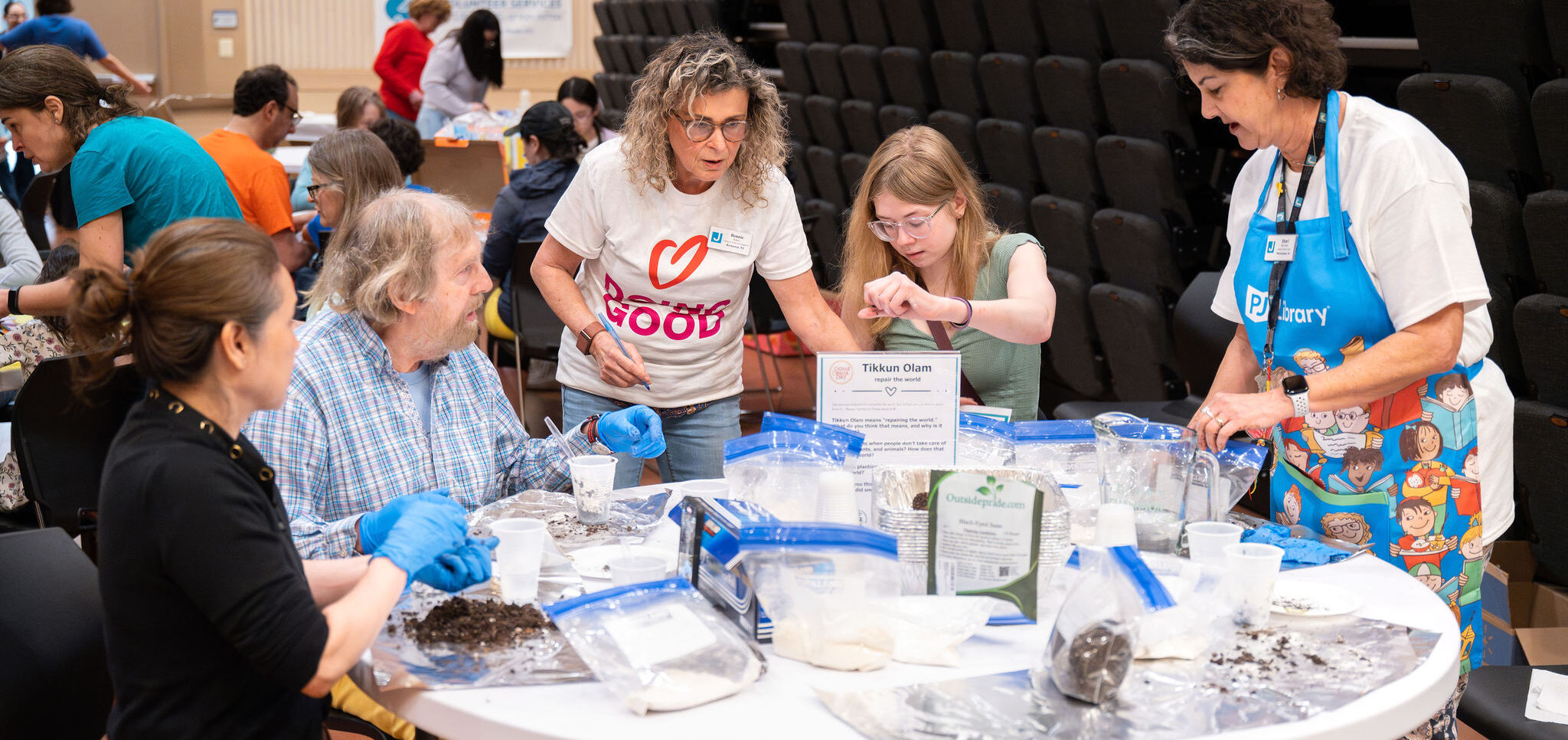
Later, I meet with Amy (Director of Partnerships and Family Engagement) to plan Good Deeds Day on April 12th. We’re organizing hands-on projects for all ages: 

  • For neighbors: Wrapping silverware for shelters or making flowers for seniors. 
  • For kids: Assembling snack packs for local students. 
  • For community: Sorting kosher food for Yad Yehuda. 
  • For pets: Crafting recycled toys for local animals. 

During the meeting, Megan, a volunteer who jumped right into the DMV community upon moving here, texts to say she’s coming to Good Deeds Day. Amy and I wrap up by discussing the community garden; our volunteer Michelle is already asking for the schedule. Whether it’s planting veggies, baking challah, or joining family programs, Michelle always shows up. 

Closing the Day 

As I head out, I greet Abby and her husband. She’s off to improv class while he heads to a board meeting. Beyond her great humor, for years, Abby has been our champion breakfast cook for Hypothermia Prevention. 

Driving home, I feel incredibly lucky. I spend my day doing amazing, meaningful things, surrounded by caring, thoughtful, and fun people — and I also have a salary!  Our community is a living example of gmilut hasadim (acts of loving-kindness) and tikkun olam (repairing the world). Our volunteers come for the impact, but they stay for the community. 

Join us — become a volunteer at the Pozez JCC.