

The Yoms: An American and Israeli Perspective
We, as a Jewish community, are readying ourselves for holidays that call on us to hold joy and sadness at the same time. They are The Yoms: Yom HaShoah, Yom HaZikaron, and Yom HaAtzmaut.
At sundown tomorrow begins Yom HaShoah, or Holocaust Remembrance Day, which commemorates the millions of Jewish lives stolen by Nazi terror and lifts up stories of Jewish resistance. A week later is Yom HaZikaron, Memorial Day for fallen soldiers and victims of terror in Israel. And then, just 24 hours later, comes Yom HaAtzmaut, Israel Independence Day — linking the very existence of the State of Israel to those who risked everything for it.
Here at the J, we create space with intention, encouraging our community to sit in our pain, learn with and from one another, and engage with remembrance to process our emotions and power our resilience.
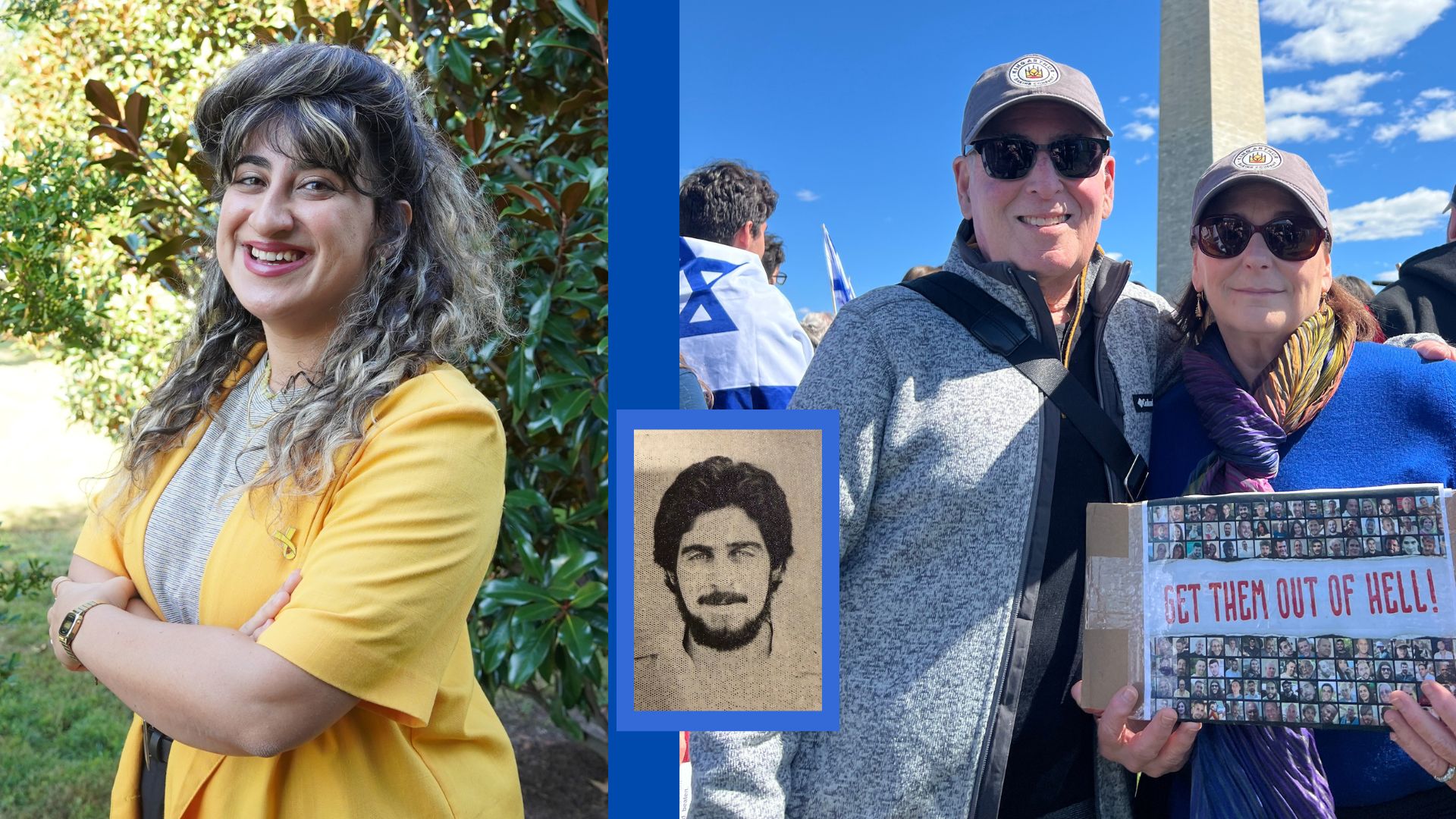
The coming days will be meaningful and challenging for our community. To give perspective, Chen Sara Mordechai-Kedar, our shlicha (Israeli emissary), and David Selden, a philanthropist and lay leader with a long-standing commitment to Jewish life, share their experiences on The Yoms and reflect on personal moments of commemoration and celebration.
From Stories to Memory
Our shlicha Chen Sara Mordechai-Kedar is a self-described “Tel Avivian girl” who grew up in Rishon LeZion, a city on the shore of the Mediterranean Sea.
Every year — on the same day, at the same time — she heard the tzfirot, the sirens marking Yom HaZikaron. The first one sounded at sundown, lasting for one minute. The second one blared the next morning for two minutes.
During those moments, all of Israel stopped. Traffic came to a halt. No one moved or talked. Everyone stood in stillness and silence.
“As a kid, you try to be very serious and do this, but sometimes you end up laughing because you’re embarrassed. You’re only starting to understand the rules and experiences of your country,” Chen said. “But when you grow up, and especially after army service, this day completely changes for you.”
As Chen, now 32, grew older, she felt the weight of loss. Yom HaZikaron was no longer a secondhand experience, lived through stories told by a parent or a sibling. She had served as a commander in the Israeli army. She had stories of her own and people she held in her heart on Yom HaZikaron.
“This wasn’t my family’s sadness anymore; it was mine,” Chen said. “I could stand and think about people I knew who died. Suddenly this tzfira, this alarm, was very, very meaningful for me. And I couldn’t imagine hearing a kid laugh during it.”
And now, especially after October 7, transitioning from Yom HaZikaron to Yom HaAtzmaut is a greater challenge.
“Even when everybody is celebrating in the streets,” she said, “I always remember that it’s not so easy anymore.”
For Chen, this year will mark her first time teaching on The Yoms. She is helping to organize a series of programs, including a Taste of Israel, a celebration of Israeli culture and community, and Pass the Trauma, Please, an author talk with second-generation Holocaust survivor Todd Diamond about the effects of generational trauma, loss, and legacy.
Chen plans to draw on her own experiences to help our community learn and tap into the hope of the Jewish people.
“If you have a place like the J that can accept everyone, where everybody’s welcome to come and tell other people in the community what they feel, then that is a very meaningful place,” Chen said. “Here, people can show up and say what is on their hearts.”
Holding Grief, Holding Hope
David Selden, a lifelong philanthropist and poet, was raised in a Zionist home. He was surrounded by stories. Many he wrote himself. Others were passed down, like the story of his grandfather, who escaped persecution in Poland and found refuge in what is now Israel.
“Foundational experiences don’t leave you,” he said. “They persist and they grow and they reform.”
He had many of his own foundational experiences in Israel, beginning in 1973.
David, now 71, was a long-haired college kid in Massachusetts on October 6, 1973 — the beginning of the Yom Kippur War in Israel. He wanted to help, and after speaking with his parents, he went to Israel to volunteer.
His new home was Kibbutz Manara, perched on the northern border of Lebanon. He tended chickens and dodged rockets. He refused to speak English because he was determined to learn Hebrew. Using his arm as a sort of dry erase board, David wrote down Hebrew words so he would not forget them.
“Kibbutz Manara. I live there in my memories,” David said. “It bound me to the people. To history. To my place in that history.”
He stayed long after the war and was there for The Yoms, in a small apartment with his host family and a visitor. On Yom HaZikaron, the visitor wailed louder than the siren, David remembered. He had lost his only son in the Yom Kippur War.
“I can hear him now,” he said.
Remembrance is personal in Israel, as everyone knows someone who has been killed in uniform or in a terrorist attack. Across a small country where nearly every citizen has to serve to mitigate security threats, loss and sacrifice are a part of daily life.
“From the sirens to the community to the very feelings of those who have suffered the greatest loss of all,” David said, “there’s a lot to be learned by how Israelis mourn together in ways that you can only learn by doing.”
He remembered another moment in Israel: visiting Yad Vashem, the Holocaust museum. David stood before a memorial honoring children who were slaughtered, and then, he stepped outside.
“I saw the hills. I saw life,” David said. “I could express gratitude and look at a future that’s still there and evolving.”
Then and now, David navigates the tension of The Yoms as he does every day: with poetry. Some of his recent poems have been influenced by the devastation impacting Israel and its neighbors. He said reality will challengeour search for light on The Yoms — but we must look for it.
“The idea of still finding that joy and fulfilling that catharsis, that mandate to express joy, is going to be incredibly challenging given what is going on. But we will do it. Because we are human beings. This is what we do.”
| Affirmation A poem by David Selden As our world shudders and contorts physics, heartaches erupt as old volcanos sometimes do, buds in dormant trees peek out, seeking sun’s blessing, we remain fixed on the given, not the taken |
The J continues to thrive because of Jewish leaders like Chen and David and because of generous donors like you. Your support ensures the J remains a place where we can be together in joy and sadness as we honor The Yoms. To continue sustaining our community from generation to generation, make a gift of your own.