Join the J in June to receive $109 off enrollment fee! Learn More.

When April Fools’ Day Meets the Seder Table: Leaning Into the Silly This Passover

 This year, something wonderfully unexpected is happening: the first night of Passover falls on April Fools’ Day. And honestly? We think that it is worth celebrating.  

Passover has always had room for joy, laughter, and a healthy dose of chaos, especially when little ones are at the table. This year, instead of resisting the overlap, why not lean all the way into it? 

The seder is already full of built-in silliness. We dip twice, we recline, we open the door for Elijah, and we spend a good portion of the evening asking questions and telling a story through food. Children are not just welcome at the seder table, they are central to it, reciting the four questions and providing up-to-the minute commentary. The Haggadah is designed to spark curiosity, invite participation, and make the night feel different from all other nights. A little extra playfulness only deepens that spirit. 

What might a silly seder look like? Hey Alma (a Jewish culture website) recently asked their community to post about their silliest Passover traditions and received a delightful collection of creative ideas.  

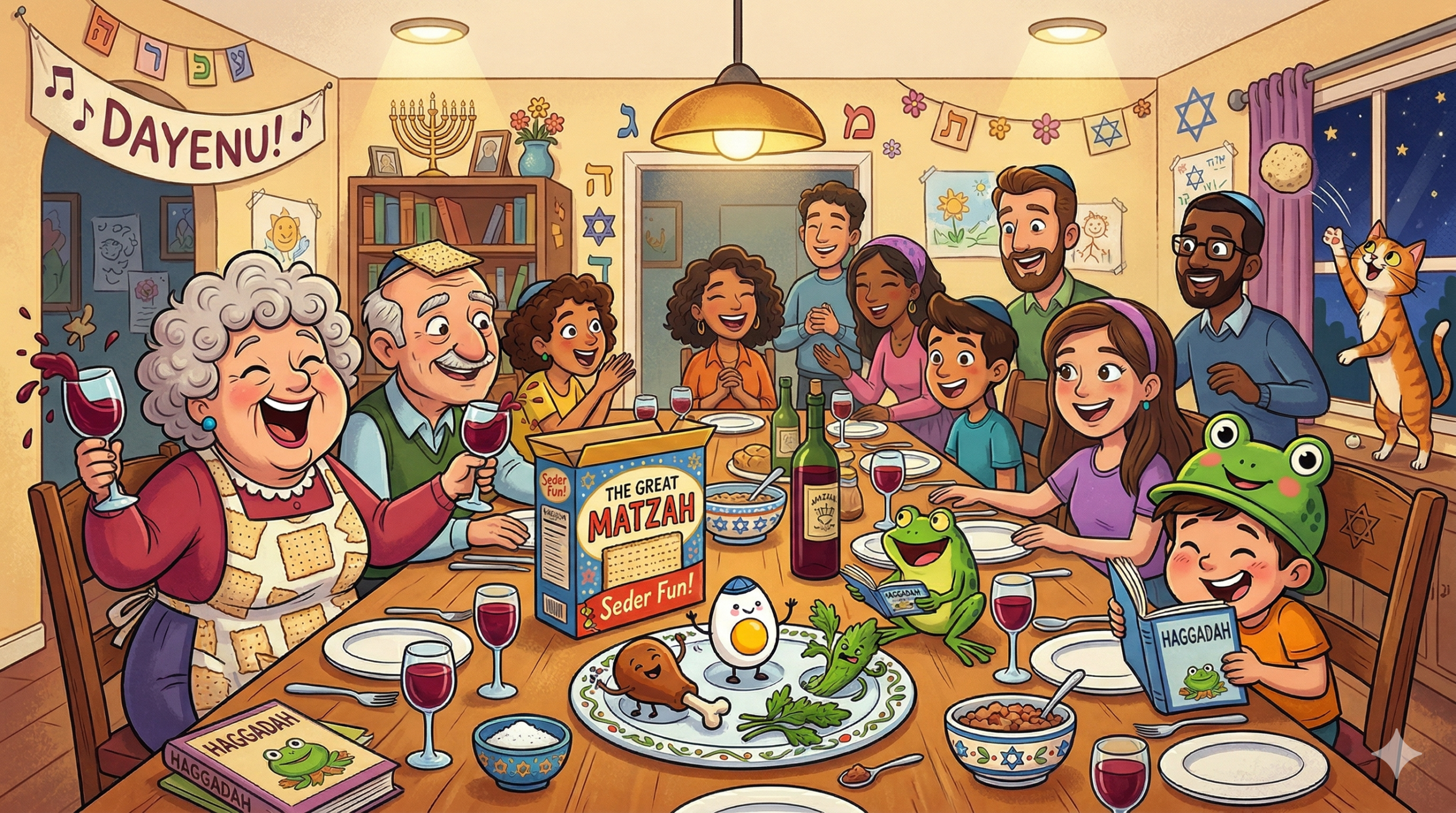
Some families build matzah houses the way others build gingerbread houses, complete with vegetables and toppings. Others throw marshmallows during the plague of hail, hide tiny plastic frogs in each other’s shoes and cups, and have someone arrive in costume when the door is opened for Elijah. One family does Mad Libs for the Maggid. Another reads from a decades-old Haggadah full of typos and considers it a sacred obligation to pronounce every word exactly as printed. 

These traditions are a wonderful reminder that Jewish families have always found ways to make the seder their own. 

If you are looking to take the fun a step further, Recustom (an online platform for exploring Jewish rituals) offers a Comedy Seder Haggadah that brings humor directly into the ritual. A comedy-forward Haggadah can be a wonderful way to keep older kids and teens engaged, welcome guests who are new to the seder, and shake things up in the most joyful way possible. 

Here are a few easy ideas to bring more laughter to your table this year: 

  • Give everyone a silly prop to wear during the telling of the plagues. We use plague headbands at our house, but you can also buy masks and finger puppets.  
  • Let the kids be in charge of sound effects during the recitation of the Passover story or ask them to act it out. 
  • Try reading a section of the Haggadah in a funny accent, chosen at random.  
  • Change the rules to the afikomen game. Reverse the roles of kids and adults in stealing, hiding, and searching for the afikomen. Or, allow each kid to hide a piece of matzoh and decide who should find it.  
  • Give a silly afikomen prize (brussels sprouts, anyone?). 
  • Recite the seder backwards. 

The seder has survived thousands of years not because it stays the same but because every generation brings something new to the table. This April Fools’ Passover, we hope yours is filled with matzah, meaning, and more than a few good laughs. Chag Sameach! Happy Passover! 

Young families looking for more Passover fun can join two Growing Jewish Families events during the holiday.  

How saying ‘yes’ makes a difference to Sunrise families facing pediatric cancer 

Last weekend, the Pozez JCC and Sunrise Day Camp – Greater Washington answered with a resounding “yes!” to our campers’ most-asked question: “Can we have more camp?” 

The Camp YES Day event, one of Sunrise’s monthly Family Fun Day activities, brought back that magic summer feeling with a chance to revisit everyone’s favorite camp activities outside of the camp season. 

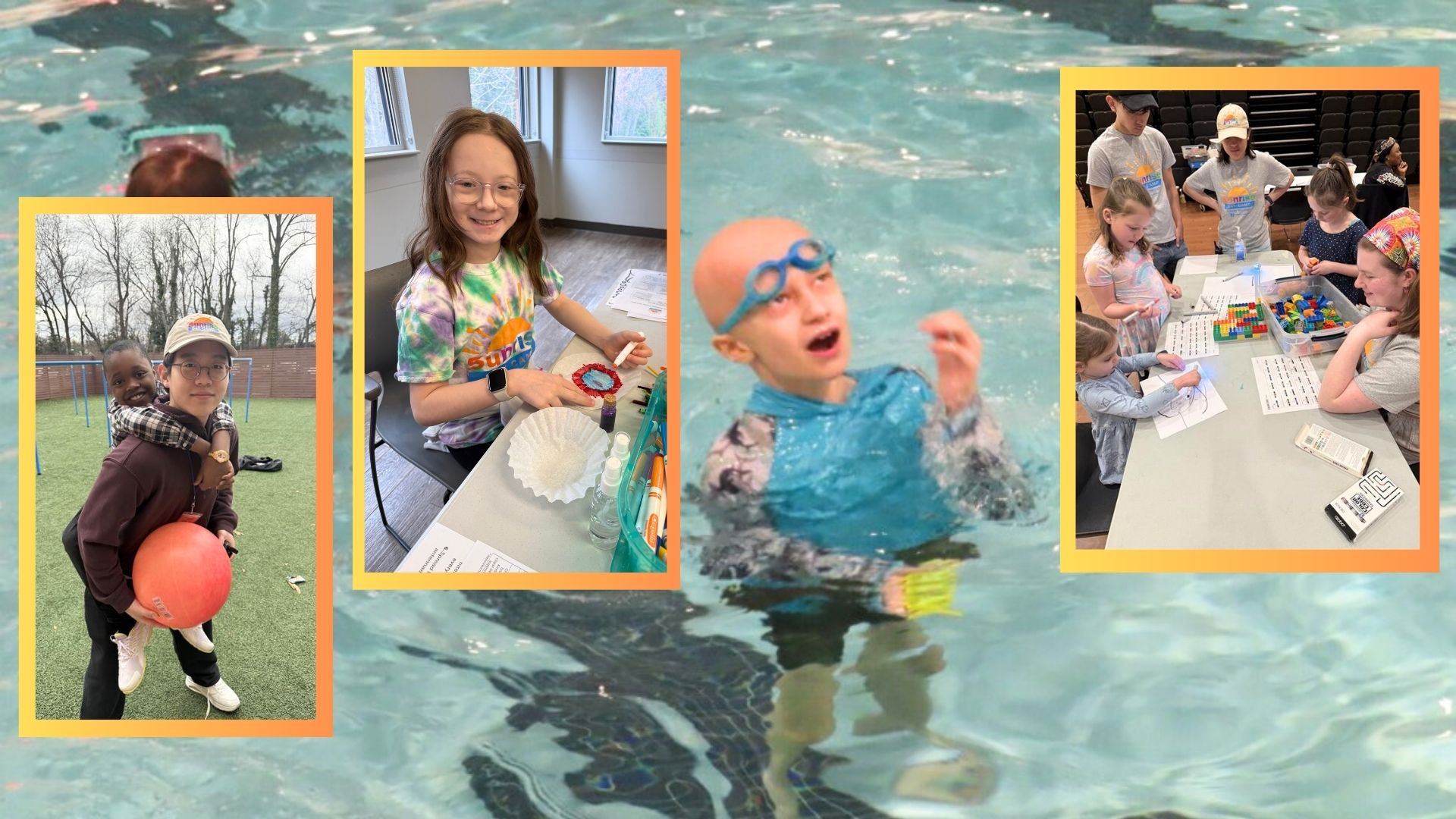
The day was all about letting campers do the things they love most. They got to swim, participate in STEAM activities and arts and crafts, take center stage at drama class, and reunite with their camp friends. Our campers are a mix of kids facing cancer, survivors, and their siblings, but at Sunrise Day Camp, they’re all just kids having fun. 

Camp YES Day was a slice of camp with one important twist. Parents were welcome to attend and join the activities with their families. This Family Fun Day was our most attended yet, with 65 participants representing 16 families and 17 dedicated staff members coming together for a day filled with laughter, connection, and unforgettable camp fun. 

When they weren’t busy enjoying special activities with their kids, parents shared the impact the various Sunrise programs have had on their families. These conversations reminded us that the impact of Sunrise extends beyond the campers themselves — it touches entire families. 

One family shared how the COVID pandemic felt doubly isolating when one of their sons was diagnosed with cancer and long hospital stays separated the two boys during treatments. During those difficult days, Sunrise on Wheels — Sunrise’s in-hospital program — gave the family something to look forward to, as the team brought toys, games, and fun directly to the hospital. That summer, Sunrise Day Camp brought the boys back together, while also bringing joy and normalcy back into their lives. 

When asked to describe Sunrise in just one word, parents responded with “blessing,” “connection,” “belonging,” “community,” “hope,” “home,” and “joy.” Each word reflected a different experience, but together they painted a powerful picture of what Sunrise means to the families we serve.  

What we heard from families on Camp YES Day is that Sunrise is more than a camp. It’s a source of hope during one of the most difficult periods of their lives. Sunrise Day Camp continues to be a place where entire families feel connected — to other families who understand the realities of having a child with cancer, to caring staff, and to a community that surrounds them with encouragement and support. 

Events like Camp YES Day also serve as an important reminder that programs like Sunrise exist because of the generosity of our community. All Sunrise programs, including our six-week summer day camp, Family Fun Days, and Sunrise on Wheels hospital programming, are offered completely free of charge. We can’t create that magic alone. 

As we look ahead to our fifth summer, Sunrise Day Camp – Greater Washington invites the larger community to come together to support our programs. Because when we say “yes” to children with cancer and their siblings, incredible things happen: joy returns, friendships grow, and families find a place where they truly belong.  

Say “yes” today and support Sunrise Day Camp. DONATE NOW 

In Conversation with the Curator: Graphic Designer & Illustrator Hillel Smith 

Parsha Posters 
By Hillel Smith 
In the Bodzin Art Gallery until April 12, 2026 

I learned about the art of Hillel Smith through one of my luckiest web searches. It was 2017, and the J had just been vandalized. As a curator, I can choose to respond to the many societal challenges around us in my practice. Since this challenge was deeply personal and traumatic to our community, I felt it was necessary to respond by putting together a Jewish Graffiti exhibition. I began a search for artists to highlight.  

At the time, Hillel’s website said he was L.A.-based, but his work was so compelling, I reached out anyway. And guess what? He had just moved to D.C. It was bashert (fate). Hillel shared his original art and some photographs of murals he’d painted in the U.S. and Israel alongside work by local artist Ari Krasner (the Spray Paint Lady) and artist, author, and educator Rabbi Mat Tonti

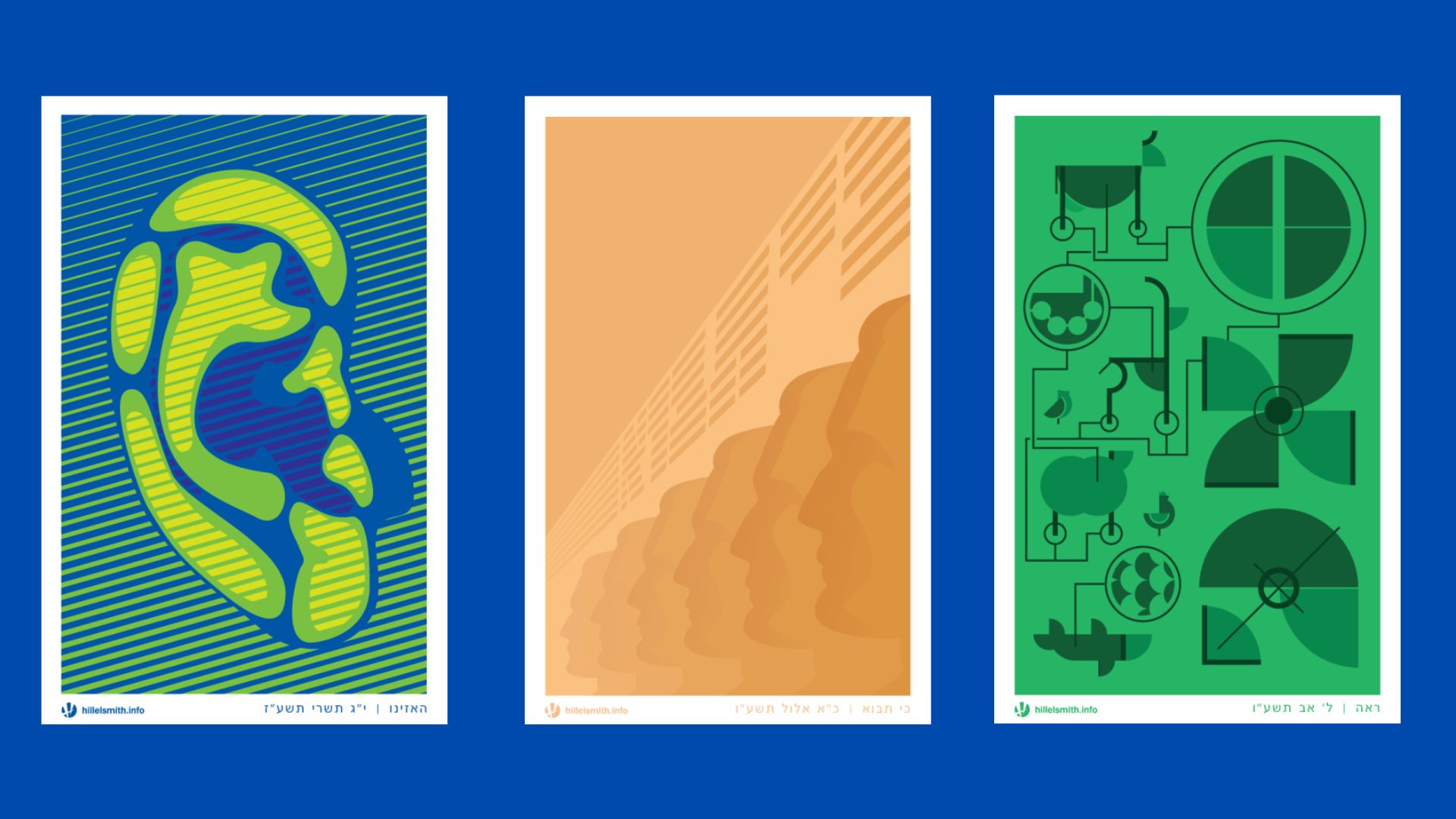
Shortly after the Jewish Graffiti exhibition turned spray paint into a positive medium for our community, Hillel proudly published Parsha Posters, a book showcasing his series of posters “advertising” the parshat hashavua (weekly Torah portion). The posters utilize innovative Hebrew typography — each one integrates the Hebrew name of the parsha into the illustration — and a bold, graphic aesthetic to tell biblical stories in a new way.  

It’s a pleasure to collaborate with Hillel again and to show all 54 parashiyot in the Bodzin Art Gallery. Posters and books are for sale, with a portion of proceeds benefitting the Bodzin Art Gallery. 

You are a graphic designer, illustrator, mural painter, and Judaica artist. How did you get started and what keeps you going? 

I’ve been drawing and painting since I was a little kid and could first hold a marker. My parents noticed how much I enjoyed making things and enrolled me in various art classes from a young age. As I got older, the classes became more technical and formal, and I learned to draw with charcoal and paint with watercolors and oil paints.  

I designed our high school yearbook and did layout for the school newspaper, without any idea that this was an actual discipline called graphic design. I just wanted to make it look good. In college, I had the opportunity to try all kinds of media and techniques, like silkscreen and woodblock printing, and took my first formal design classes.  

I worked as a graphic designer for a number of years after graduating and took every opportunity to include my own illustrations in projects for clients. Over time, I flipped my hyphens from designer-illustrator to illustrator-designer and added more titles to the string, like muralist and papercraft artist.  

I’d hate being restricted to only one medium for the rest of my life. Picking the right form for each idea and project is what keeps things interesting for me. Ultimately, I’m grateful that I’ve made a career out of doing what I love. 

When did Judaism start to inspire the content of your art?  

I had always kept the Jewish and artistic parts of my life separate. It wasn’t many years after college that I was experimenting with spray paint techniques and thought it would be interesting to make a set of Hebrew letters on a poster that only appeared when two stencil layers lined up.  

I had some success previously getting pieces into local group art shows but was having trouble coming up with ideas for new work. A friend saw this Hebrew piece and encouraged me to do more, saying it was totally different than what was out there and clearly something I was passionate about. It was good advice!  

I did start making more art with Jewish content and found endless inspiration there. It’s been over a decade and I haven’t stopped. 

Tell us more about your process of creating a poster for each of the 54 parashiyot in the Torah?  

Every week, usually on Saturday afternoon or Sunday, I’d sit down with a chumash (the Torah in book format) and read the parsha for the upcoming week. I had a few different translations at home, and I’d cycle through them or even read a few at the same time to see how they were interpreting the text. 

As I read, I tried to pinpoint what felt like the emotional core of the parsha, meaning the single most important event (in my eyes, at least) that everything else centered on. Sometimes that would be the most famous story we all know, but sometimes it was a lesser-known passage or an artistically overlooked one.  

Then to turn that object, person, event, or action into a poster, I’d pay close attention to any visual language the text used, as well as think about colors and other iconography that could create the feeling I wanted to convey. These stories resonate with us today because they carry emotional heft. My ultimate goal was to create something that expressed that feeling in a focused way, rather than telling a literal story.  

I usually started with too much detail and stripped it away until it felt as clean and direct as I wanted. As I mulled and sketched, I’d try to figure out how the name of the parsha fit into the illustration. Maybe the letters made up an object, or maybe they were each an object or the background. Sometimes my first sketch was perfect and turned into the final art with minimal editing. Sometimes it took a bunch of tries to get a concept that worked, and the drawing itself needed a lot of revision.  

But no matter how much trouble I had, or even if I thought I should scrap a concept and start over, I still needed to finish the poster by Thursday to post it online and mail it out before Shabbat! After a whole year, I had read the entire Torah for the first time from beginning to end and made a body of work I’m really proud of. 

 What advice do you have for aspiring artists? 

First, an artist is someone who makes art, so to be an artist you have to actually go make things. Don’t let fear of imperfection or artist’s block or judgment stop you. Keep making things. The more you make things, the better you get at making things, which is convenient.  

Personal challenges — like “I’m going to illustrate every Torah portion for a year” or “I’m going to do this Instagram challenge of drawing a celebrity every day for a month” — can be helpful in giving you a thing to do and a framework to do it in without having to think much about it. Plus, those quick deadlines will prepare you for the real world of client deadlines and teach you about understanding when a piece is done enough. (Put another way, every piece has an arbitrary stopping point. Knowing when to stop and move on is incredibly important.)  

While you don’t have to show everything you make to other people, if you want to be a professional, you have to get used to sharing your art. Then you can also get feedback on how to make your art better. Be open to feedback, and don’t take it personally! There’s always room for improvement.  

Next, take every opportunity to learn new skills, whether by taking formal classes in or after school or doing online tutorials. You may discover a new medium you absolutely love or a technique that changes the way you approach your work.  

Finally, if you want art to be a job, you have to treat it like one. You have to get up every day, work, take feedback, revise, call the piece finished, put it out into the world, do all the admin stuff (until you’re rich enough that you can hire someone to do it for you), and then do it all again the next day. It’s hard! But if you enjoy it and find good opportunities and good people to work with and work for, you’ll have a great time. 

ECLC in DC: Early Childhood Advocacy in Action on Capitol Hill

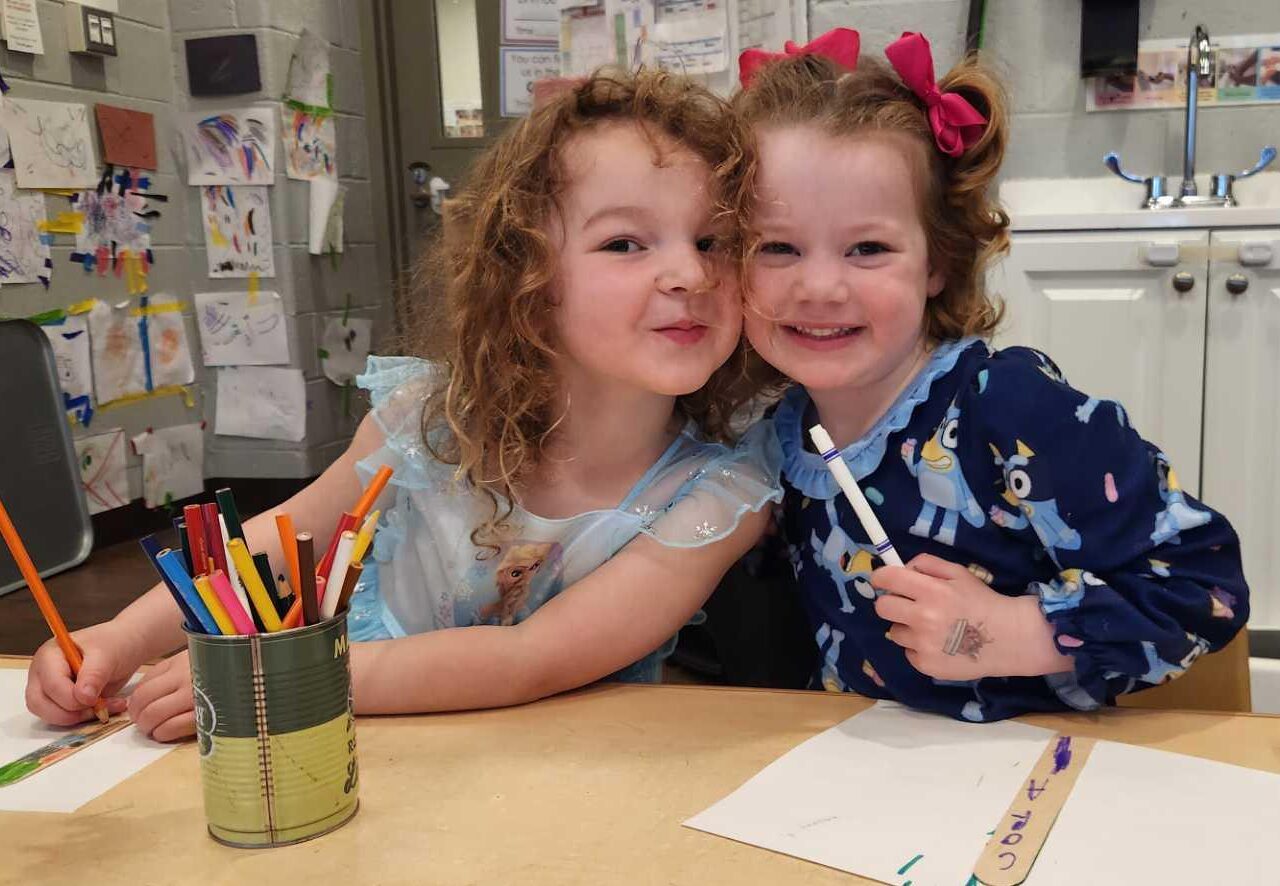
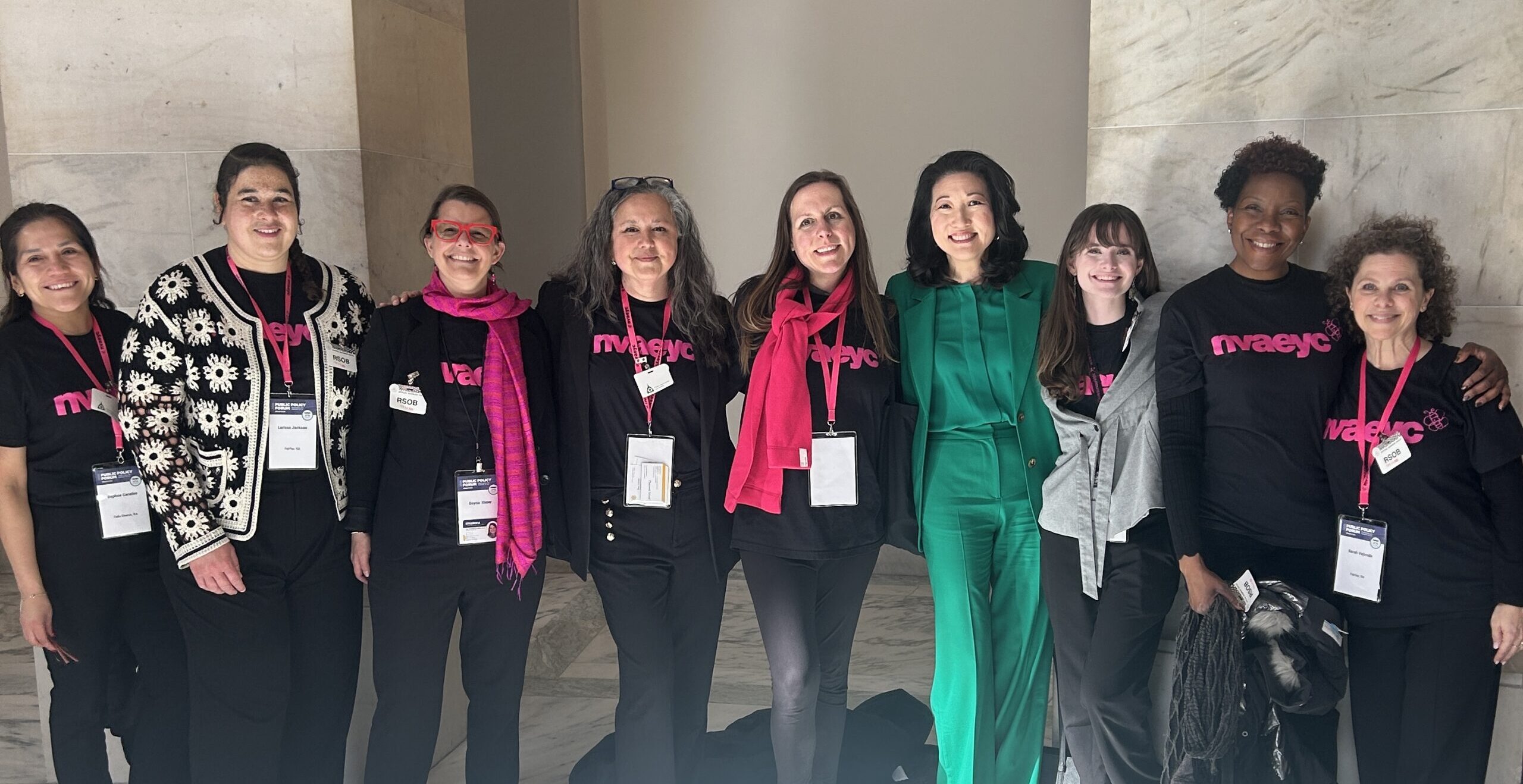
Advocacy is about turning passion into purpose and purpose into action. Last month, members of the Pozez JCC’s Early Childhood Learning Center (ECLC) had the meaningful opportunity to bring the voices of early childhood educators from Northern Virginia directly to policymakers in Washington, D.C. 

In addition to our roles at the ECLC, Sarah and I serve as advocacy co-chairs for the Northern Virginia Association for the Education of Young Children (NVAEYC). As part of this advocacy committee, we organize and facilitate a six-week Advocacy Leadership Training Program (ALTP) for early childhood educators. 

At this year’s training, we explored the foundations of early childhood education policy at the local, state, and federal levels and discussed how legislation impacts the affordability, quality, sustainability, and reach of educational programs. Together, we unpacked complex policy issues and practiced crafting advocacy messages. Early childhood professionals carry firsthand knowledge of how government policies affect children, families, and educators, and we practiced how to translate our experiences into compelling stories that resonate with decision-makers. 

The culmination of the ALTP is attending the National Association for the Education of Young Children’s Public Policy Forum. Our cohort joined more than 400 early childhood professionals from across the country to gather on Capitol Hill in late February to advocate on behalf of early childhood education. Walking the halls of the Capitol alongside educators, center directors, advocates, and allies from nearly every state was energizing as we united in a shared sense of purpose. 

We stepped into meetings with policymakers and congressional staff to advocate for meaningful investment and support. Our cohort members spoke candidly about the realities facing today’s early childhood education workforce: rising operational and tuition costs, persistent staffing shortages, compensation challenges, and cuts to programs that families, children, and early childhood educators rely on. We also shared positive personal stories about children who thrived with the right support, families who successfully balanced work and caregiving, and educators who remained committed despite significant challenges. 

For many participants, this was their first time engaging directly with elected officials or their staff. After the training they received, they were able to hold confident, informed conversations on Capitol Hill. Watching early childhood professionals recognize their own power as changemakers was inspiring.  

 The experience was deeply personal for us as facilitators as well. Supporting this cohort reminded us that advocacy is not separate from our professional roles; it is an extension of our responsibility to children and families. When we advocate, we honor the relationships we build every day in our programs and ensure that decision-makers understand what is truly at stake. 

At the Pozez JCC, we know that early childhood education is a cornerstone of strong communities. Our commitment to high-quality, relationship-based early learning extends beyond our classrooms and into the broader systems that shape opportunities for young children. Advocacy is one way we embody our values. 

 We returned from the Public Policy Forum feeling connected, motivated, and hopeful. We are proud to represent our ECLC community, proud of our ALTP cohort, and proud to stand with hundreds of early childhood advocates nationwide who believe that investing in young children is investing in our collective future. 

Written by: Sarah Vejvoda, ECLC Atelierista and Hillary Gile, ECLC Pedagogista