

In Conversation with the Curator: Photographer Lloyd Wolf
A Joyful Noise: Photographs of Klezmer Musicians
In the Bodzin Art Gallery December 15, 2025 – January 26, 2026
Closing reception and klezmer concert with Mrs. Toretsky’s Nightmare
January 24, 2026
7:00 PM-9:00 PM
Register here
Fun fact: The very first time I showed my art outside of school was at the Bodzin Art Gallery (yes, this very one) in 2007 in a group photography exhibition called Living Tradition, curated by Lloyd Wolf. Sharing Lloyd’s A Joyful Noise: Photographs of Klezmer Musicians is quite a full-circle moment — and a blessing.
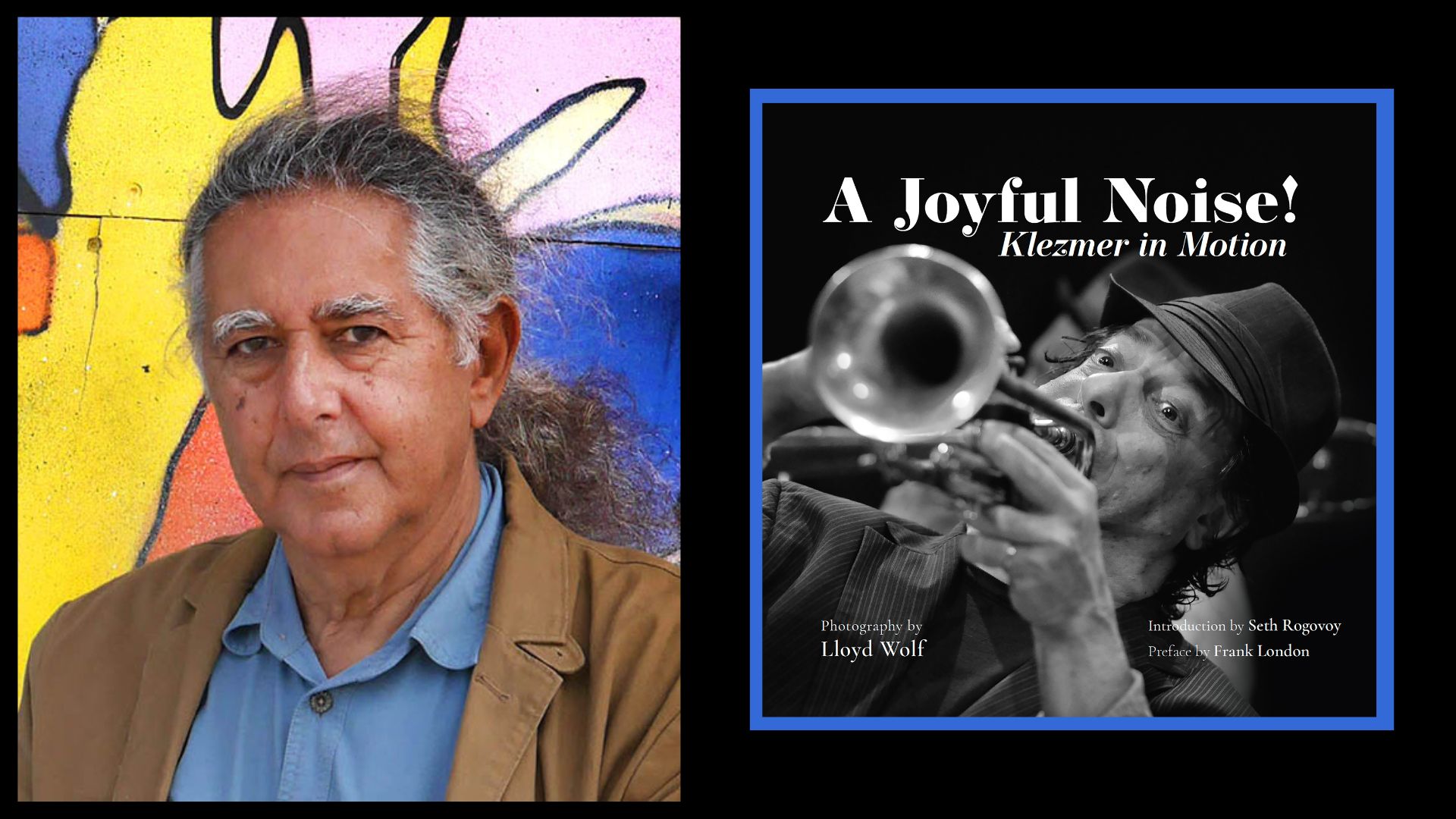
The exhibit’s 45 dynamic images serve as a large-scale glimpse into Lloyd’s A Joyful Noise: Klezmer in Motion. The book, published in 2025 by the Klezmer Institute, contains three decades worth of Lloyd’s photographs depicting historic and modern klezmer musicians. These photographs sizzle with energy, capturing the soul and sound of the performers in visual form. Books will be available for purchase at the J.
For me, Lloyd Wolf is kind of a big deal. Here’s what he has to say about his work and this exhibition.
Your documentary photography spans many topics from musical movements (klezmer, the Grateful Dead) to the diversity of our local community (Columbia Pike Documentary Project (CPDP) to Jewish joy in your Jewish Mothers and Jewish Fathers series and Jewish pain in your March of the Living series. It’s all so very… human. How do you decide what to turn your lens toward and share with others?
Hard question! The camera has given me a visa to travel into many aspects of life. Some projects I have done that were particularly meaningful came from editorial or non-profit organization assignments; others were self-directed.
My personal strengths and interest are in exploring the human condition. I am interested in how individuals and communities experience life and have done numerous projects exploring both the joys and travails of existence.
I have obviously done quite a bit of work in the Jewish community. Coming to grips with my own, with our, Jewish identity, particularities, history, customs, and culture is something I can interface with in depth using a camera.
The ongoing DC street shrines to homicide victims photographs (Shrines – Washington’s Other Monuments) come from my work volunteering with “Shooting Back” and “Streets to Skills,” programs where I and other artists mentored homeless and formerly homeless kids in photography. I developed a close relationship with one of the kids I worked with, Dion Johnson. During the 1990s he lost four relatives to murder in 13 months. It was terribly hard on him.
I began to have a more visceral awareness of the impact ongoing violence has in our society and how society at large so often ignores the fundamental causes of violence, particularly when it occurs in minority communities. Each person killed is an entire world — a fundamental Jewish concept.
I am not a public policy expert, police officer, elected official, or social worker, but I know art can be the catalyst for conversation and action.
When did you start making photos of klezmer musicians, and when did you know it was going to be an ongoing project and book?
I was 40 years old when this collection of photographs began. In December 1992, I got an assignment from Jeff Rubin, then the editor of Bnai Brith’s magazine, Jewish Monthly. I was sent to New York City to do a photo essay on two of the new klezmer revival groups, Kapelye and the Klezmatics.
I met up with Kapelye at a rehearsal space in the Workman’s Circle building. It was a plain room, and I had to light the whole thing in order to render the pictures at magazine-quality on transparency film. It made things a bit awkward with the big strobe lights flashing.
I didn’t know any of the members — Henry Sapoznik, Adrienne Cooper, Ken Maltz, Eric Berman, and others — who put up with the interference with grace and began to weave their musical spells. I can’t recall the particular melody but do remember being in awe of Adrienne Cooper’s deep, commanding, matronly voice and presence.
The next night I was to meet Frank London from the Klezmatics at the Bottom Line club. We talked and shared a meal before their show, and we hit it off. Here was a Jew of my generation, who fully expressed his passion and art in an explicitly ethnic context, and with exceptional skill and brio.
He, and the other band members at the time — Dave Licht, Alicia Svigals, David Krakauer, Lorin Sklamberg, and Paul Morrisett — delivered a masterfully exhilarating concert, with music I had never heard expressed so vividly and knowledgably. Their rendition of the Chasidic tune “Shnirele Perele” (String of Pearls) opened up something deep, a grand opening of the soul in sound.
I began to photograph their other performances when I could and, as time went on, to document other klezmer ensembles, sometimes on assignment but more often to fulfill my growing interest in and love for the music and the musicians themselves. I began to know more about the music — the repertoire, the history, the practitioners, the dances and other cultural expressions associated with it.
From one side of my family background and school studies, I had a passing knowledge of German and, because of linguistic relationships, was able to appreciate bits and pieces of Yiddish, intertwined with the music. I had heard what we now term klezmer music at my mother’s parents’ home in the Bronx, where the radio was often tuned to the Yiddish station, but I did not consciously know of or listen to the music until the late 1980s.
As my relationship with the scene grew, I created album cover art for some of the bands, and after some time realized I had created a perhaps unique archive of many of the musicians and the music itself, though in visual rather than sonic form. I have photographed hundreds of bands and individual performers, from the internationally known to small community ensembles and one-gig projects.
Somewhere about 10 years ago, I realized I had a unique and coherent collection of work and began the process of getting the work published in book form. It took some time to get the right publisher, but the work of three-plus decades has come to fruition in what I trust is a meaningful, uplifting, and engaging form.
This body of work has concentrated my focus and held my attention for over three decades. I just like klezmer music. A lot. And I trust the pictures convey some sense of what I find so compelling about it.
Taking photos at a concert with low lighting and lots of movement poses some challenges. Tell us more about how you overcome those obstacles with the right equipment. When do you know you’ve captured a winning shot?
This project was made over three decades, so the technical issues have changed. In the first years using film, it was harder to render indoor concert performances with any assurance. There were some very high-speed black and white films available by 1992, but they were rather grainy, and I couldn’t predict the outcomes with much certainty — both technically and aesthetically.