

In Conversation with the Curator: Graphic Designer & Illustrator Hillel Smith
Parsha Posters
By Hillel Smith
In the Bodzin Art Gallery until April 12, 2026
I learned about the art of Hillel Smith through one of my luckiest web searches. It was 2017, and the J had just been vandalized. As a curator, I can choose to respond to the many societal challenges around us in my practice. Since this challenge was deeply personal and traumatic to our community, I felt it was necessary to respond by putting together a Jewish Graffiti exhibition. I began a search for artists to highlight.
At the time, Hillel’s website said he was L.A.-based, but his work was so compelling, I reached out anyway. And guess what? He had just moved to D.C. It was bashert (fate). Hillel shared his original art and some photographs of murals he’d painted in the U.S. and Israel alongside work by local artist Ari Krasner (the Spray Paint Lady) and artist, author, and educator Rabbi Mat Tonti.
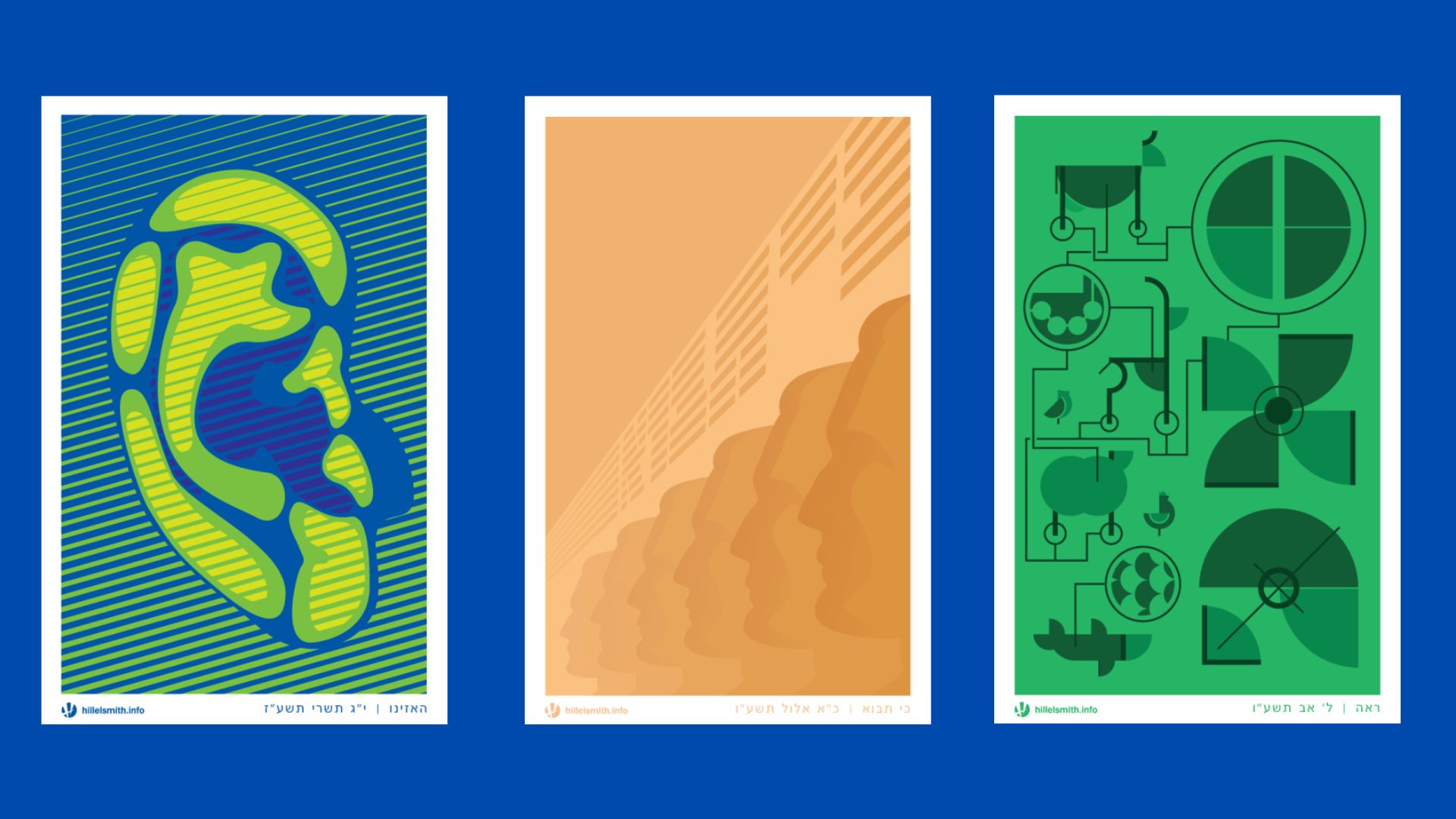
Shortly after the Jewish Graffiti exhibition turned spray paint into a positive medium for our community, Hillel proudly published Parsha Posters, a book showcasing his series of posters “advertising” the parshat hashavua (weekly Torah portion). The posters utilize innovative Hebrew typography — each one integrates the Hebrew name of the parsha into the illustration — and a bold, graphic aesthetic to tell biblical stories in a new way.
It’s a pleasure to collaborate with Hillel again and to show all 54 parashiyot in the Bodzin Art Gallery. Posters and books are for sale, with a portion of proceeds benefitting the Bodzin Art Gallery.
You are a graphic designer, illustrator, mural painter, and Judaica artist. How did you get started and what keeps you going?
I’ve been drawing and painting since I was a little kid and could first hold a marker. My parents noticed how much I enjoyed making things and enrolled me in various art classes from a young age. As I got older, the classes became more technical and formal, and I learned to draw with charcoal and paint with watercolors and oil paints.
I designed our high school yearbook and did layout for the school newspaper, without any idea that this was an actual discipline called graphic design. I just wanted to make it look good. In college, I had the opportunity to try all kinds of media and techniques, like silkscreen and woodblock printing, and took my first formal design classes.
I worked as a graphic designer for a number of years after graduating and took every opportunity to include my own illustrations in projects for clients. Over time, I flipped my hyphens from designer-illustrator to illustrator-designer and added more titles to the string, like muralist and papercraft artist.
I’d hate being restricted to only one medium for the rest of my life. Picking the right form for each idea and project is what keeps things interesting for me. Ultimately, I’m grateful that I’ve made a career out of doing what I love.
When did Judaism start to inspire the content of your art?
I had always kept the Jewish and artistic parts of my life separate. It wasn’t many years after college that I was experimenting with spray paint techniques and thought it would be interesting to make a set of Hebrew letters on a poster that only appeared when two stencil layers lined up.
I had some success previously getting pieces into local group art shows but was having trouble coming up with ideas for new work. A friend saw this Hebrew piece and encouraged me to do more, saying it was totally different than what was out there and clearly something I was passionate about. It was good advice!
I did start making more art with Jewish content and found endless inspiration there. It’s been over a decade and I haven’t stopped.
Tell us more about your process of creating a poster for each of the 54 parashiyot in the Torah?
Every week, usually on Saturday afternoon or Sunday, I’d sit down with a chumash (the Torah in book format) and read the parsha for the upcoming week. I had a few different translations at home, and I’d cycle through them or even read a few at the same time to see how they were interpreting the text.
As I read, I tried to pinpoint what felt like the emotional core of the parsha, meaning the single most important event (in my eyes, at least) that everything else centered on. Sometimes that would be the most famous story we all know, but sometimes it was a lesser-known passage or an artistically overlooked one.
Then to turn that object, person, event, or action into a poster, I’d pay close attention to any visual language the text used, as well as think about colors and other iconography that could create the feeling I wanted to convey. These stories resonate with us today because they carry emotional heft. My ultimate goal was to create something that expressed that feeling in a focused way, rather than telling a literal story.
I usually started with too much detail and stripped it away until it felt as clean and direct as I wanted. As I mulled and sketched, I’d try to figure out how the name of the parsha fit into the illustration. Maybe the letters made up an object, or maybe they were each an object or the background. Sometimes my first sketch was perfect and turned into the final art with minimal editing. Sometimes it took a bunch of tries to get a concept that worked, and the drawing itself needed a lot of revision.
But no matter how much trouble I had, or even if I thought I should scrap a concept and start over, I still needed to finish the poster by Thursday to post it online and mail it out before Shabbat! After a whole year, I had read the entire Torah for the first time from beginning to end and made a body of work I’m really proud of.
What advice do you have for aspiring artists?
First, an artist is someone who makes art, so to be an artist you have to actually go make things. Don’t let fear of imperfection or artist’s block or judgment stop you. Keep making things. The more you make things, the better you get at making things, which is convenient.
Personal challenges — like “I’m going to illustrate every Torah portion for a year” or “I’m going to do this Instagram challenge of drawing a celebrity every day for a month” — can be helpful in giving you a thing to do and a framework to do it in without having to think much about it. Plus, those quick deadlines will prepare you for the real world of client deadlines and teach you about understanding when a piece is done enough. (Put another way, every piece has an arbitrary stopping point. Knowing when to stop and move on is incredibly important.)
While you don’t have to show everything you make to other people, if you want to be a professional, you have to get used to sharing your art. Then you can also get feedback on how to make your art better. Be open to feedback, and don’t take it personally! There’s always room for improvement.
Next, take every opportunity to learn new skills, whether by taking formal classes in or after school or doing online tutorials. You may discover a new medium you absolutely love or a technique that changes the way you approach your work.
Finally, if you want art to be a job, you have to treat it like one. You have to get up every day, work, take feedback, revise, call the piece finished, put it out into the world, do all the admin stuff (until you’re rich enough that you can hire someone to do it for you), and then do it all again the next day. It’s hard! But if you enjoy it and find good opportunities and good people to work with and work for, you’ll have a great time.