

Cultivating Empathy in the ECLC: Empowering Conflict Resolution and Repair with Young Children
“Say you’re sorry.”
“Give a hug.”
These are typical adult responses when conflict arises among young children. But are they the best instruction for developing brains? Within the ECLC, Pozez JCC’s Early Childhood Learning Center, we have spent a lot of time reflecting on what it really means to just say sorry when one child upsets or hurts a peer.
The word “sorry” to young children (not to mention to many adults) is merely a word said to excuse whatever wrong was done. In my role as an educator and the ECLC’s Pedagogista, I have witnessed many a child, once prompted to say “sorry,” run off to happily engage in something else, while the other child remains hurt and upset.
Telling children to “give a hug” to resolve conflicts presents additional concerns. Young children are developing foundational understandings of selfhood, bodily autonomy, and agency. While hugs can be a wonderful means of connecting, forcing hugs as a means of resolving conflict can have the opposite effect, especially when it disregards the child’s level of comfort with physical touch.
So how might we more intentionally address altercations between young children? The ECLC educators have been developing an approach to conflict resolution and repairing harm that takes inspiration from restorative justice practices and principles. Restorative justice centers on relationship repair, accountability, and the needs of all involved parties.
What does this practice look like? Say Rachel knocks down Eli’s block tower. An adult will prompt Rachel to check in on her distraught friend, giving her the words to ask: ”Are you ok?”
Space is then held to listen to Eli’s response. If he replies “no,” the next step is for Rachel to ask, “What can I do to make you feel better?” This allows her to hold accountability and seek to repair the harm done.
Again, space is given for Eli to respond. This is a critical part of the process, ensuring that his expressed needs are heard. He may state that he’d like Rachel to apologize or request that she help him rebuild the toppled tower. Frequently, I’ve heard a child state that they want the other to “be more careful” or “try not to do that again.”
In this scenario, the adult facilitators would also check in with Rachel to address her needs, as well. They might say, “I saw that you knocked over Eli’s tower. Were you wanting to play with him? We can ask Eli if you can join in his play, or maybe you can build your own tower to knock down.”
Addressing conflict and harm in this way inevitably takes more time and effort to facilitate than simply telling children to “say sorry.” Yet overwhelmingly children from the ECLC’s 3s and 4s classes have adapted to this new approach. While some children need an adult to model the check-in process for them, by midyear, most children can actively facilitate this themselves. It’s a truly remarkable transformation to witness!
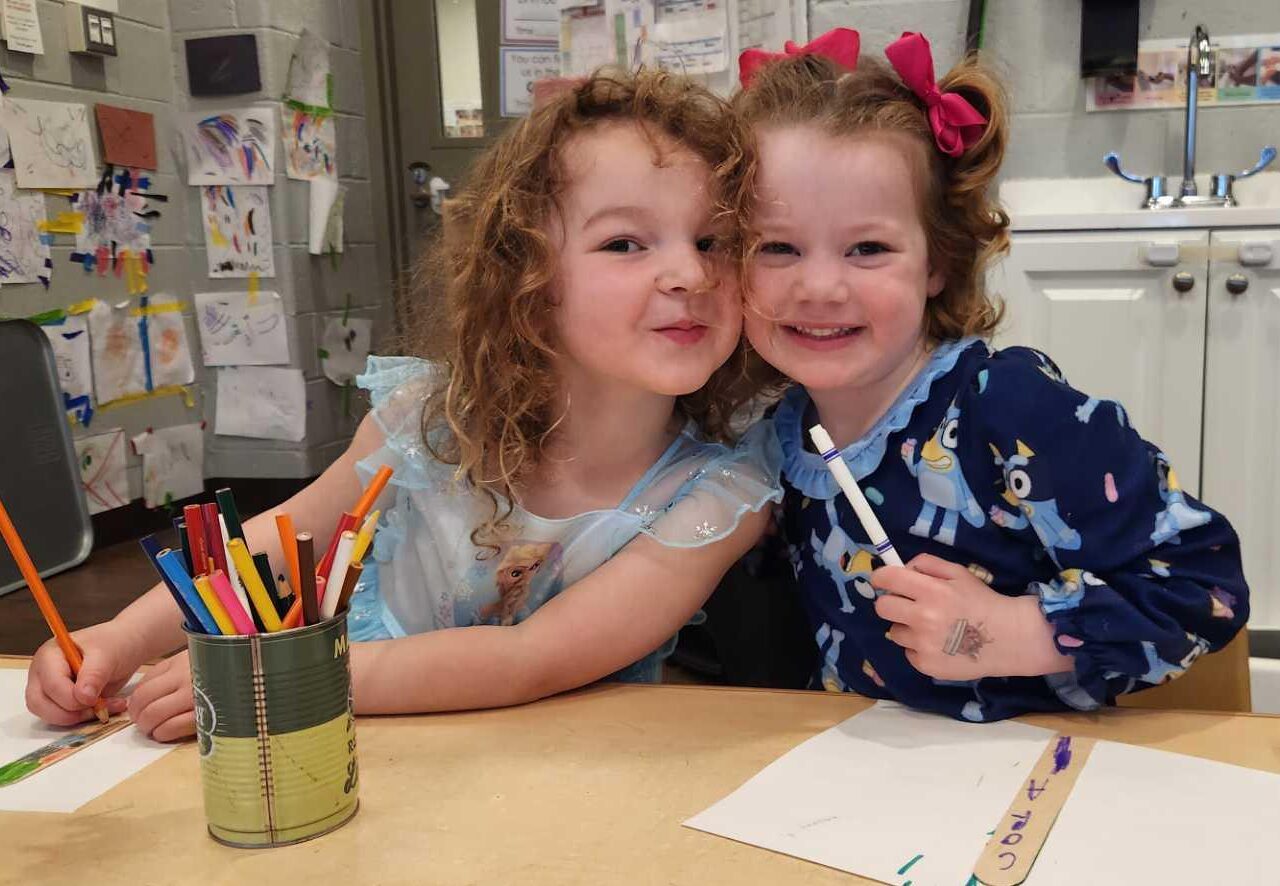
Through this process, the children can practice problem solving and explore how to better relate together. In a global state of increasing polarization, the ECLC’s hope is that a foundation can be built in this youngest generation that centers on a value of relationships, a recognition of the interconnectedness of us all, genuine care for repairing harm and resolving conflict, and a cultivation of empathy to support a better world.
Young children have a miraculous way of revealing to us as adults what it really means to be human. If they can learn these important skills, so can we.
—–
At the Pozez JCC’s Early Childhood Learning Center (ECLC), we cultivate curious, confident learners. Inspired by the Reggio Emilia approach, our nurturing environment fosters each child’s social, emotional, cognitive, and physical growth through rich, interactive experiences. We embrace Jewish values within a universally inclusive curriculum, recognizing every child as capable, competent, and deserving of respect.
Support our mission to nourish the growth of our youngest learners with a donation to the JCC or contact the ECLC to set up a tour of our licensed preschool and childcare facility.